

#619: How Much Fish Should a Healthy Diet Contain?

Find us on all podcast platforms/apps

Introduction

Most dietary guidelines recommend eating one to two servings of fish per week, often specifying that at least one serving should be oily fish. But how directly is that recommendation supported by evidence? And does adding fish to the diet improve outcomes?

This episode examines where current fish-intake recommendations originated, why findings may appear contradictory, and what substitution analyses can tell us about replacing fish with alternative options.

It also considers evidence from pescatarian and vegetarian cohorts, including whether adding fish would improve an already high-quality diet and whether removing it from a plant-forward diet is likely to provide further benefit.

Timestamps
  • [00:20] Setting out the question at hand

  • [03:26] Overview of typical fish intake recommendations

  • [07:10] Is there good evidence for suggested intakes?

  • [08:10] Historical context

  • [13:22] Key evidence: DART trial and cohort data

  • [19:27] Analysis from Mohan et al.

  • [25:04] Comparator issue: what is fish replacing?

  • [30:52] Fish protein vs. plant protein

  • [44:29] Vegetarian vs. pescatarian cohorts

  • [55:20] Conclusions

  • [01:00:50] Key Ideas segment (Premium-only)

Episode Resources

References & Further Reading

  1. Kromhout D, Bosschieter EB, de Lezenne Coulander C. The inverse relation between fish consumption and 20-year mortality from coronary heart disease. N Engl J Med. 1985.
  2. Burr ML, et al. Effects of changes in fat, fish, and fibre intakes on death and myocardial reinfarction: Diet and Reinfarction Trial. Lancet. 1989.
  3. Burr ML, et al. Lack of benefit of dietary advice to men with angina: results of a controlled trial. Eur J Clin Nutr. 2003.
  4. Mohan D, et al. Associations of fish consumption with risk of cardiovascular disease and mortality among individuals with or without vascular disease from 58 countries. JAMA Intern Med. 2021.
  5. Neuenschwander M, et al. Substitution of animal-based with plant-based foods on cardiometabolic health and all-cause mortality. BMC Med. 2023.
  6. Song M, et al. Association of animal and plant protein intake with all-cause and cause-specific mortality. JAMA Intern Med. 2016.
  7. Zheng J-S, et al. Association between animal and plant protein intake and cardiovascular disease in EPIC-CVD. Am J Clin Nutr. 2024.
  8. Tong TYN, et al. Risks of ischaemic heart disease and stroke in meat eaters, fish eaters, and vegetarians over 18 years of follow-up. BMJ. 2019.
  9. Appleby PN, et al. Mortality in vegetarians and comparable nonvegetarians in the United Kingdom. Am J Clin Nutr. 2016.
  10. Abris GP, et al. Vegetarian dietary patterns and mortality in Adventist Health Study-2. Am J Clin Nutr. 2024.

About the Hosts

Alan Flanagan, PhD is a Postdoctoral Research Fellow at the University of Surrey, UK, where he previously completed a PhD in nutrition and a master’s degree in Nutritional Medicine. Dr. Flanagan is the founder of Alinea Nutrition, an online education hub dedicated to providing impartial, science-based nutrition reviews and analysis.

He has published in fields such as chrononutrition and research methods in nutrition (see publications).

Dr. Flanagan is a regular co-host of the podcast, as part of his role as Research Communication Officer at Sigma Nutrition.

Danny Lennon is the founder of Sigma Nutrition and host of the popular podcast Sigma Nutrition Radio since 2014. Danny has a master’s degree (MSc.) in Nutritional Sciences from University College Cork, in addition to a BSc. Degree in Biology and Physics.

He is the co-creator of the course Applied Nutrition Literacy with Dr. Alan Flanagan.

And he is currently a member of the Advisory Board of the Sports Nutrition Association, the global regulatory body responsible for the standardisation of best practice in the sports nutrition profession.


Study Notes

Overview

The episode examined why many dietary guidelines converge on roughly one to two servings of fish per week, usually including oily fish, and how strongly that recommendation is supported by direct evidence.

  • The recommendation has an evidential history rather than being an arbitrary heuristic, but the evidence base combines different exposures, populations and study designs.
  • Fish, oily fish, seafood, fish-oil supplements, EPA and DHA are not interchangeable exposures.
  • Associations appear more favourable in secondary prevention, meaning among people with established vascular disease, than in generally healthy populations.
  • The health implication of adding or removing fish depends partly on what food changes in the opposite direction and on the quality of the starting diet.
  • Current evidence does not establish that fish is indispensable for a healthy diet, nor that people consuming guideline-compatible amounts would improve health by reducing intake to zero.

Useful Terminology

  • Primary prevention: preventing a first cardiovascular event in people without established cardiovascular disease.
  • Secondary prevention: preventing recurrent events or death in people who already have cardiovascular or vascular disease.
  • Comparator: the food, nutrient or intake level against which fish is compared. A result cannot be interpreted fully without knowing the comparator.
  • Substitution model: an observational statistical model estimating the association expected when one dietary component is lower and another is correspondingly higher, while total energy or protein is held constant.
  • Residual confounding: distortion that remains after adjustment because relevant differences between groups were unmeasured, measured imperfectly or modeled inadequately.
  • Hazard ratio (HR): a relative comparison of event rates over time. An HR of 0.85 corresponds to a 15% lower relative rate, not a 15-percentage-point reduction in absolute risk.
  • Confidence interval (CI): the range of estimates compatible with the data and model. For a hazard ratio, an interval crossing 1.00 does not conventionally exclude no association.
  • EPA and DHA: long-chain omega-3 fatty acids found most abundantly in oily fish. Evidence about isolated EPA/DHA or fish-oil capsules is not automatically evidence about eating fish.
  • Pescovegetarian: a dietary pattern that excludes meat but includes fish; it may differ from both omnivorous and vegetarian diets in many other respects.
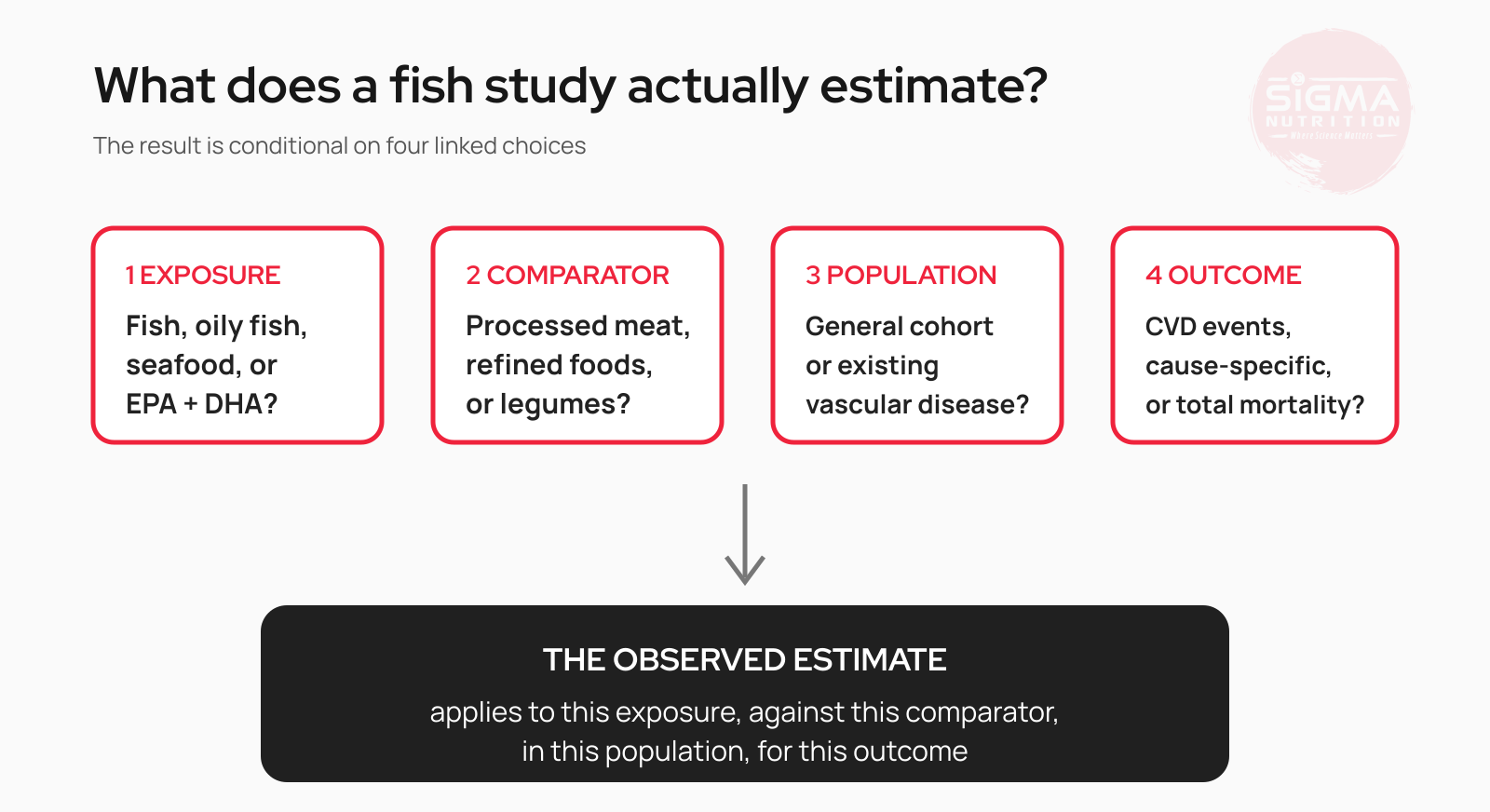
Figure 1. A result about fish intake is conditional on what was measured, what fish was compared with, who was studied and which outcome was analysed.

How to Read the Evidence

The episode’s central question is not answered by a single comparison. Each claim should be separated into four layers:

  1. What the study found: the reported association or trial result in the studied population.
  2. What it may mean: a plausible interpretation that respects the exposure, comparator and design.
  3. What it cannot establish: observational associations do not prove causation, and a nutrient or supplement trial

Premium Content

You are currently not signed-in as a Premium subscriber.

To view our Premium content, please log-in to your account or subscribe to Premium.