
A new meta-analysis published out of Johns Hopkins University has given more credence to the practice of attempting to positively alter the gut microbiome by consuming prebiotics, probiotics and synbiotics.
The paper, titled ‘Dietary Alteration of the Gut Microbiome and Its Impact on Weight and Fat Mass: A Systematic Review and Meta-Analysis’, looked at the impact of prebiotics, probiotics and synbiotics on body weight, body mass index (BMI) and fat mass in humans.
Given the sheer volume of research that has been pumped out related to the impact of the microbiome on health over the past decade, it’s exciting to see some more pieces of this complex puzzle starting to be put together. However, I am still firmly in the camp of urging caution when it comes to what we can be certain of in this field. It’s so common to see nutrition “experts” or health gurus wax lyrical about “optimizing the microbiome” through specific dietary and supplementation strategies. And it’s just nonsense for the most part.
So when looking for answers on the topic, I would urge practitioners to rely on the highest forms of evidence (rather than alternative medicine blogs). Of course, well-designed randomized control trials can give us interesting insights. But only when we look at a large portion of these trials and form an idea of the where the consensus is leaning, we can likely move to more evidence-based recommendations.
Systematic reviews and meta-analyses are one of the best tools we have in science to achieve this. So I wanted to highlight this recently published paper, it’s findings and throw up some questions related to potential implication for practice.
Methodology
All interventional trials (randomized or non-randomized) utilizing prebiotics/probiotics/synbiotics in supplement or food-based form in adult human individuals (18 and older) with BMI ≥ 25 (overweight and obese) were included, while studies with children or pregnant patients were excluded. The use of any food or supplement influencing the gut microbiome (probiotic, prebiotic, synbiotic) was considered as the exposure, and weight, BMI and fat mass changes in individuals following dietary intervention were the primary outcomes.
The primary outcome measure was the difference in mean change in BMI/body weight and fat mass comparing pre-/pro-/syn-biotics to placebos.
After the application of inclusion and exclusion criteria, 21 studies remained, thus yielding 33 study arms. Of these study arms, 22 were probiotic, six prebiotic and five synbiotic.
The majority of studies had healthy participants with a BMI ≥ 25. However, some studies included patients with diabetes mellitus or pre-diabetes, metabolic syndrome and non-alcoholic fatty liver disease (NAFLD). One study assessed the use of probiotics and prebiotics in patients post-Roux-en-Y gastric bypass [38]. The median duration of follow up in the studies was 12 weeks (range 2–24 weeks). Body composition and fat mass were determined using dual-energy X-ray absorptiometry (DXA) in the majority of studies (55%, n = 6) assessing fat mass, followed by bioelectric impedance (36%, n = 4) and body composition analyzer
Results
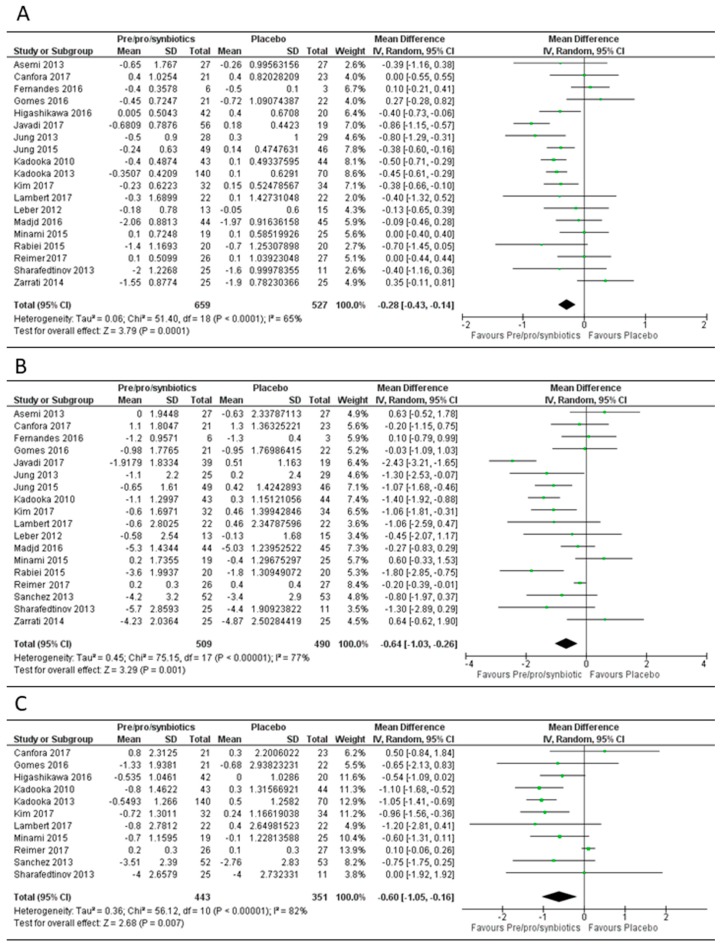
When any dietary modulation agent (prebiotic/probiotic/synbiotic) was compared to the placebo in 19 evaluable study arms, the mean difference in BMI was significant at −0.28 (95% CI −0.43, −0.14), p < 0.001. The mean difference for any agent was also significant for a reduction in body weight (−0.64 kg (95% CI −1.03, −0.26), and p < 0.001) in 18 evaluable study arms. Fat mass reduction was evaluated in 11 study arms and was statistically significant with a mean difference of −0.60 kg (95% CI −1.05, −0.16), p < 0.001. There was a significant heterogeneity among the study arms for BMI, weight and fat mass (I2 > 50%) for any dietary modulation agent (prebiotic/probiotic/synbiotic).
However, when it comes to informing practice it may be more useful to examine probiotics and prebiotics separately…
Effect of Probiotics
- The effect of probiotics on BMI was evaluated in 14 study arms
- Overall, probiotics led to a significant decrease in BMI compared to placebo (overall mean difference −0.33 (95% CI −0.47, −0.18), p < 0.001).
- The overall effect of probiotics on body weight reduction was significant, with an overall mean difference of −0.65 kg ((95% CI −1.12, −0.18), p < 0.01) in the 13 study arms that were evaluated.
- Overall, a significant reduction in fat mass was also seen, with eight study arms using probiotics, leading to a mean difference of −0.94 kg ((95% CI −1.17, −0.72), p < 0.001).
- There was significant heterogeneity in the study arms for BMI and body weight with I2 > 50%. However, for fat mass, the included probiotic study arms exhibited no heterogeneity (I2 = 0%). Heterogeneity in meta-analysis refers to the variation in study outcomes between studies. If there is very little variation between trials then I² will be low
Effect of Prebiotics
- Prebiotics only had a marginal effect on the reduction of BMI, with a mean difference of −0.27 ((95% CI −0.56, 0.02), p = 0.07) in the five study arms evaluated (Figure 5). However, there was a significant reduction in body weight, with five study arms demonstrating a mean difference of −0.90 kg ((95% CI −1.77, −0.02), p = 0.04). Fat mass was evaluated in three prebiotic study arms with no significant change. Similar to probiotics, the prebiotic study arms for BMI and weight showed a significant heterogeneity (I2 > 50%); however, this was not significant for fat mass.